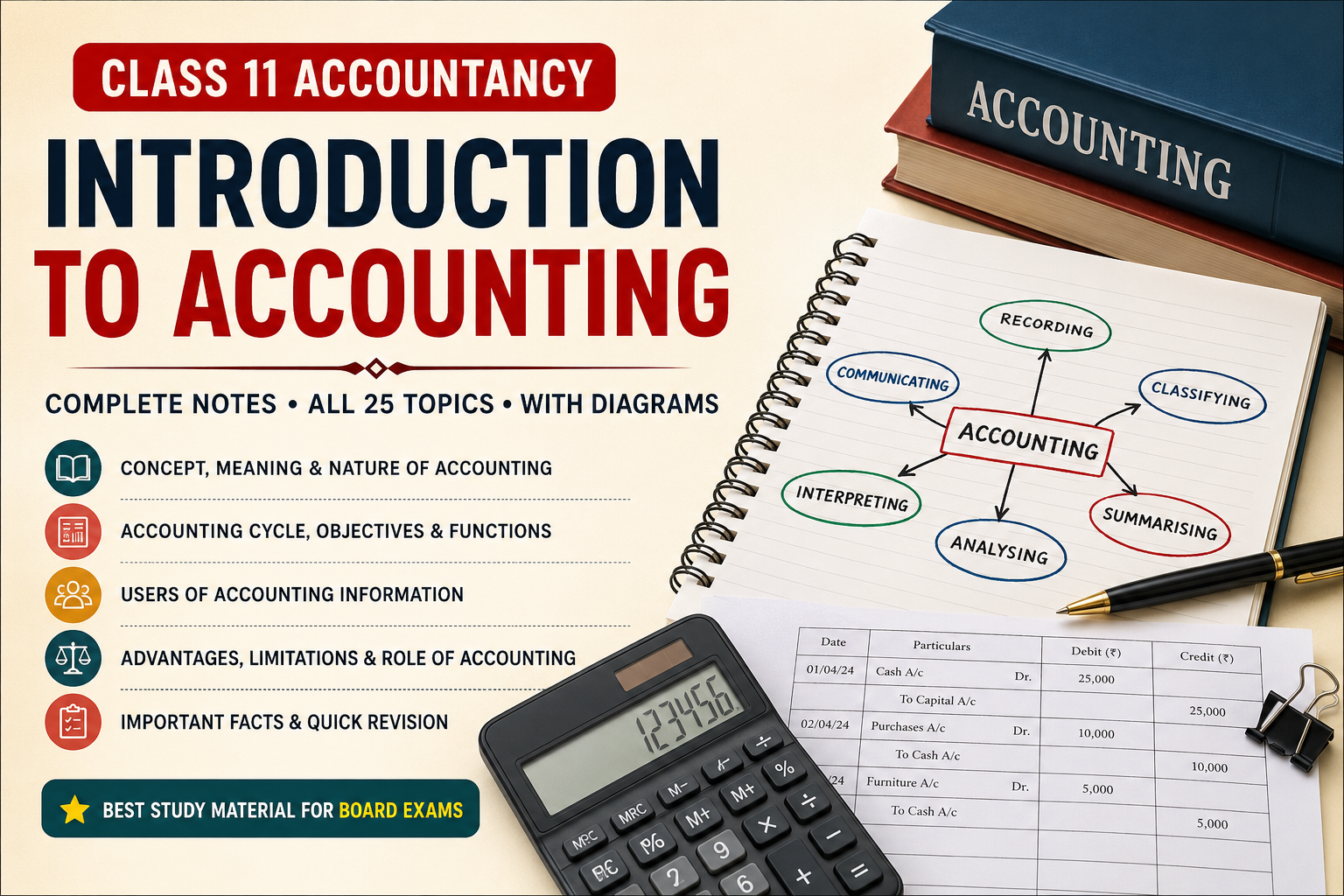
Class 11 Introduction to Accounting Notes for board exam preparation with complete explanation, diagrams, accounting cycle, objectives, limitations and important questions.
Introduction to
Accounting
Class 11 Introduction to Accounting Notes
Accounting is the process of identifying, measuring, recording, classifying, summarising, analysing, interpreting and communicating financial information to its users for decision-making.
- Ancient Era: Clay tablets in Mesopotamia (~3000 BC) — earliest records.
- Luca Pacioli (1494): Published Summa de Arithmetica — introduced Double-Entry System. Called "Father of Accounting".
- Industrial Revolution: Need for systematic accounting grew with large-scale businesses.
- Modern Era: Corporate accounting, computerised accounting, IFRS/IND-AS standards.
Book-keeping is the systematic recording of financial transactions in the books of accounts in a regular and methodical manner.
Systematic, regular, complete, permanent, consistent recording of all monetary transactions.
To maintain permanent records; ascertain profit/loss; know financial position; provide legal evidence.
Accounting covers all economic activities of an entity — recording transactions, preparing financial statements, auditing, taxation, cost control, and management decision-making. It extends to individuals, firms, companies, governments, and non-profit organisations.
| Basis | Book-Keeping | Accounting |
|---|---|---|
| Scope | Narrow — recording only | Wider — includes analysis & interpretation |
| Stage | Primary stage | Secondary stage (starts where BK ends) |
| Skill | Clerical in nature | Requires analytical ability |
| Objective | Maintain permanent records | Provide info for decisions |
| Personnel | Book-keeper | Accountant |
Book-keeping is a part of accounting; accounting is a part of the broader field of accountancy.
| Basis | Accounting | Accountancy |
|---|---|---|
| Meaning | Process of recording, classifying & summarising | Complete discipline / subject of study |
| Scope | Practical activity | Theoretical + practical body of knowledge |
- Systematic recording of business transactions.
- Ascertaining profit or loss of the business.
- Determining financial position (Balance Sheet).
- Providing information to stakeholders for decision-making.
- Assisting management in planning and control.
- Legal compliance — tax, audit, company law.
Requires skill, judgement & practice to record transactions accurately.
Based on systematic principles (GAAP, Ind-AS) that are universally applied.
Collects, processes and communicates economic data to interested parties.
| Branch | Focus |
|---|---|
| Financial Accounting | Recording transactions; preparing P&L & Balance Sheet for external users. |
| Cost Accounting | Ascertainment & control of cost of production. |
| Management Accounting | Information for internal management decisions. |
| Tax Accounting | Compliance with income tax, GST, and other laws. |
| Social Accounting | Impact of business on society & environment. |
| Human Resource Accounting | Valuing human assets of an organisation. |
- Provides permanent & systematic record of all transactions.
- Helps ascertain profit/loss and financial position.
- Facilitates comparison of financial results over years.
- Assists in raising loans (banks require financial statements).
- Serves as legal evidence in disputes.
- Helps in computing tax liability accurately.
- Useful for planning, budgeting & control.
- Records only monetary transactions — ignores non-monetary events.
- Based on historical cost — does not reflect current market value.
- Subject to window dressing and manipulation.
- Ignores the effect of price-level changes (inflation).
- Does not provide detailed cost data for managerial decisions.
- Provides information after the fact — not real-time.
Want to know profitability & return on investment.
Planning, controlling & decision-making.
Assess ability to repay loans.
Tax assessment, policy, regulation.
Job security, bonus, pay revisions.
Stability of supply, company's continuity.
| Characteristic | Meaning |
|---|---|
| Understandability | Easy to comprehend for users with basic knowledge. |
| Relevance | Has the ability to influence decisions (timely & material). |
| Reliability | Free from material error; faithful representation of facts. |
| Comparability | Consistent methods; comparable across periods & entities. |
Reliability → Neutrality + Verifiability + Faithful representation
- Language of Business — communicates financial performance.
- Stewardship — managers account for owners' resources.
- Control — identifies fraud, waste, and inefficiency.
- Decision support — budgets, investment, pricing decisions.
- Legal Compliance — tax filing, company law, audit.
- Ensures accurate reporting — protects investors & public.
- Helps government collect taxes — funds public services.
- Detects & prevents fraud — safeguards stakeholders.
- Assists small businesses — enables economic growth.
- Promotes corporate governance & ethical business practices.
- Social responsibility accounting — environmental reporting.
- Father of Accounting → Luca Pacioli (1494)
- Double-Entry System → Every debit has an equal credit
- Accounting records only monetary transactions
- Book-keeping is a subset of Accounting
- Accounting is both an Art and a Science
- GAAP = Generally Accepted Accounting Principles
- Accounting Cycle starts with Source Document
- Final Accounts = Trading A/c + P&L A/c + Balance Sheet
- Qualitative info (goodwill, reputation) is NOT recorded in accounting
- Main branches: Financial, Cost & Management Accounting
2. Distinguish between Book-Keeping and Accounting. (4M)
3. Explain limitations of Financial Accounting. (3M)
4. Who are the users of accounting information and their needs? (6M)
5. Explain any four qualitative characteristics of accounting information. (4M)
For more accounting concepts visit Accounting Coach .
Read More: Class 11 Accountancy Chapter 2 Notes
These Class 11 Introduction to Accounting Notes are designed for students who want easy explanations, topper style notes, board exam preparation material and quick revision. These Introduction to Accounting Notes include all important concepts, accounting cycle, objectives and limitations in simple language.