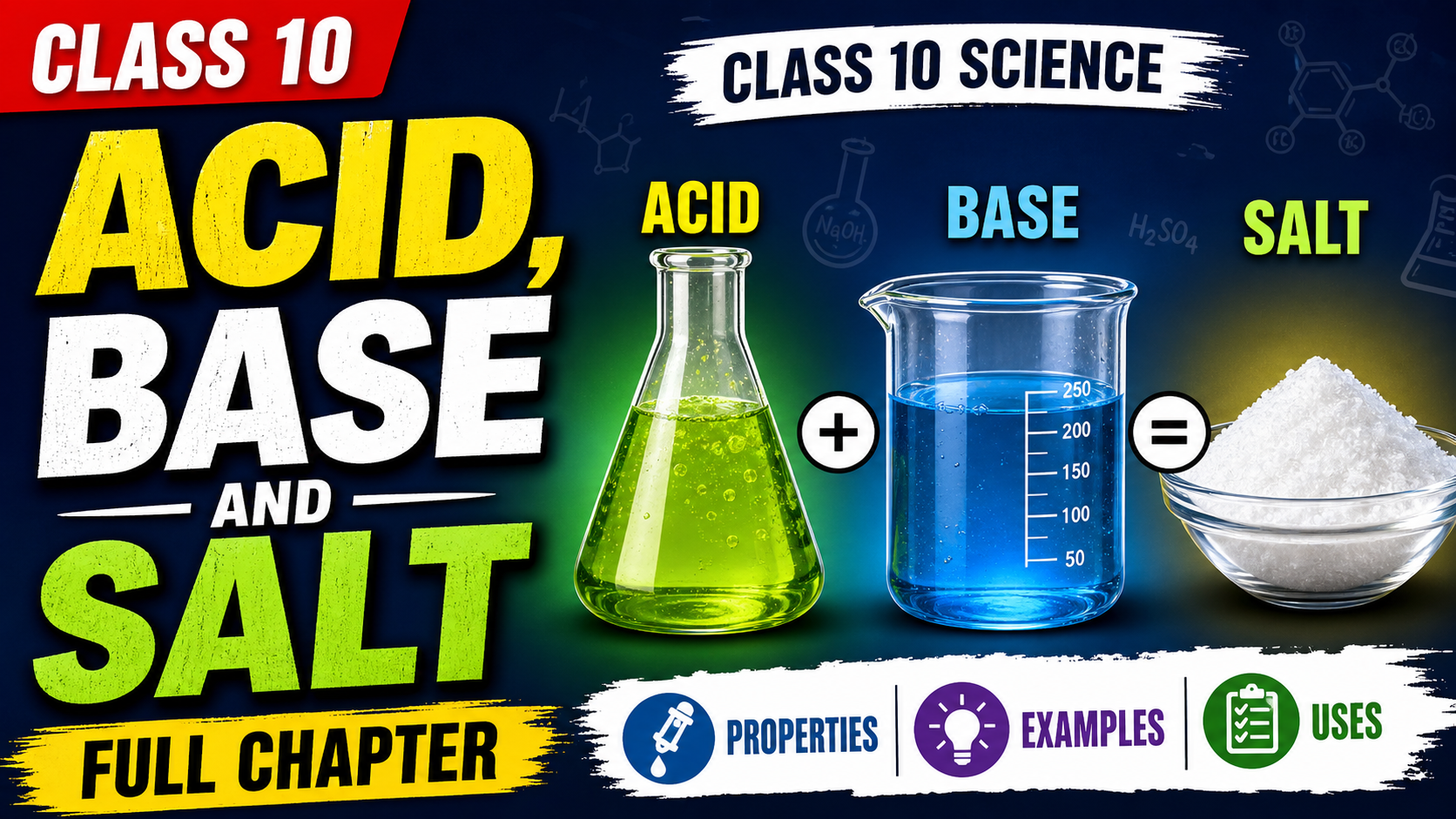
📌 Introduction
The chapter Acids, Bases and Salts is one of the most important topics in Class 10 Science. It explains the chemical nature of substances, their properties, reactions, and everyday applications.
Understanding this chapter helps students in exams as well as in real-life chemistry.
🔬 What are Acids?
Acids are substances that produce H⁺ ions (Hydrogen ions) when dissolved in water.
✅ Examples:
- Hydrochloric Acid (HCl)
- Sulphuric Acid (H₂SO₄)
- Nitric Acid (HNO₃)
📌 Properties of Acids:
- Sour in taste
- Turn blue litmus red
- React with metals to produce hydrogen gas
- Conduct electricity in aqueous solution
🧂 What are Bases?
Bases are substances that produce OH⁻ ions (Hydroxide ions) in water.
✅ Examples:
- Sodium Hydroxide (NaOH)
- Calcium Hydroxide (Ca(OH)₂)
📌 Properties of Bases:
- Bitter in taste
- Soapy to touch
- Turn red litmus blue
⚗️ What are Alkalis?
Alkalis are bases that are soluble in water.
👉 Example: NaOH, KOH
📌 Note: All alkalis are bases, but all bases are not alkalis.
🔁 Chemical Reactions of Acids
1. Reaction with Metals
Acid + Metal → Salt + Hydrogen Gas
👉 Example:
Zn + 2HCl → ZnCl₂ + H₂↑
2. Reaction with Metal Carbonates
Acid + Carbonate → Salt + CO₂ + H₂O
👉 Example:
Na₂CO₃ + 2HCl → 2NaCl + CO₂ + H₂O
3. Neutralization Reaction
Acid + Base → Salt + Water
👉 Example:
HCl + NaOH → NaCl + H₂O
🧪 Strength of Acids and Bases
Strength depends on the degree of ionization.
- Strong Acids: HCl, HNO₃
- Weak Acids: CH₃COOH
- Strong Bases: NaOH, KOH
- Weak Bases: NH₄OH
📊 pH Scale
The pH scale measures acidity and basicity (0–14).
- pH < 7 → Acidic
- pH = 7 → Neutral
- pH > 7 → Basic
📌 Examples:
- Lemon juice → pH ~2
- Water → pH 7
- Soap → pH ~10
🧂 What are Salts?
Salts are formed by the neutralization reaction of acids and bases.
👉 Example: Sodium Chloride (NaCl)
🔥 Important Salts in Daily Life
1. Baking Soda (NaHCO₃)
- Used in baking
- Makes cakes soft and fluffy
2. Washing Soda (Na₂CO₃·10H₂O)
- Used in cleaning agents
- Removes hardness of water
3. Plaster of Paris (CaSO₄·½H₂O)
- Used in making statues and casts
4. Bleaching Powder (CaOCl₂)
- Used for disinfecting water
⚠️ Importance of pH in Everyday Life
- Tooth decay: pH below 5.5 damages teeth
- Soil treatment: Farmers use quicklime to neutralize acidic soil
- Digestive system: Antacids neutralize excess acid
📚 Key Tips for Exams
✔ Learn all chemical equations
✔ Understand pH scale properly
✔ Revise common salts and their uses
✔ Practice NCERT questions
🏁 Conclusion
The chapter Acids, Bases and Salts builds a strong foundation in chemistry. It connects theoretical knowledge with real-life applications, making it both interesting and useful.
MCQs (Multiple Choice Questions)
1. Which of the following is a strong acid?
A. CH₃COOH
B. HCl
C. NH₄OH
D. Na₂CO₃
✅ Answer: B. HCl
2. Which substance turns red litmus blue?
A. Acid
B. Base
C. Salt
D. Water
✅ Answer: B. Base
3. The pH value of a neutral solution is:
A. 0
B. 14
C. 7
D. 1
✅ Answer: C. 7
4. Which gas is released when acid reacts with metal?
A. Oxygen
B. Hydrogen
C. Carbon dioxide
D. Nitrogen
✅ Answer: B. Hydrogen
5. Which of the following is an alkali?
A. CuO
B. NaOH
C. CO₂
D. HCl
✅ Answer: B. NaOH
6. Baking soda chemical formula is:
A. Na₂CO₃
B. NaHCO₃
C. CaCO₃
D. NaCl
✅ Answer: B. NaHCO₃
7. Which acid is present in vinegar?
A. Citric acid
B. Acetic acid
C. Hydrochloric acid
D. Sulphuric acid
✅ Answer: B. Acetic acid
8. Which salt is used in making Plaster of Paris?
A. CaSO₄·2H₂O
B. CaSO₄·½H₂O
C. Na₂CO₃
D. NaCl
✅ Answer: B. CaSO₄·½H₂O
9. Which of the following has pH less than 7?
A. Base
B. Acid
C. Salt
D. Alkali
✅ Answer: B. Acid
10. Which indicator is used to test acids and bases?
A. Litmus
B. Sugar
C. Salt
D. Alcohol
✅ Answer: A. Litmus
11. Which of the following is a weak base?
A. NaOH
B. KOH
C. NH₄OH
D. Ca(OH)₂
✅ Answer: C. NH₄OH
12. Tooth decay starts when pH of mouth is below:
A. 7
B. 6
C. 5.5
D. 4
✅ Answer: C. 5.5
📊 Assertion–Reason Questions
👉 Choose the correct option:
A. Both A and R are true and R is correct explanation of A
B. Both A and R are true but R is not correct explanation
C. A is true but R is false
D. A is false but R is true
1.
Assertion (A): Acids conduct electricity.
Reason (R): Acids produce ions in aqueous solution.
✅ Answer: A
2.
Assertion (A): All bases are alkalis.
Reason (R): Alkalis are soluble bases.
✅ Answer: D
3.
Assertion (A): Dry HCl gas does not change dry blue litmus paper.
Reason (R): HCl produces ions only in aqueous solution.
✅ Answer: A
4.
Assertion (A): pH of acidic solution is less than 7.
Reason (R): Acids release OH⁻ ions.
✅ Answer: C
5.
Assertion (A): Sodium hydroxide is a strong base.
Reason (R): It completely ionizes in water.
✅ Answer: A
6.
Assertion (A): Antacids are used to treat acidity.
Reason (R): Antacids are basic in nature.
✅ Answer: A
7.
Assertion (A): Neutralization reaction produces salt and water.
Reason (R): Acid reacts with base.
✅ Answer: A
8.
Assertion (A): Washing soda is used to remove hardness of water.
Reason (R): It reacts with calcium and magnesium ions.
✅ Answer: A
9.
Assertion (A): Strong acids have low pH value.
Reason (R): They ionize completely in water.
✅ Answer: A
10.
Assertion (A): Phenolphthalein turns pink in acidic solution.
Reason (R): It is an indicator.
✅ Answer: D