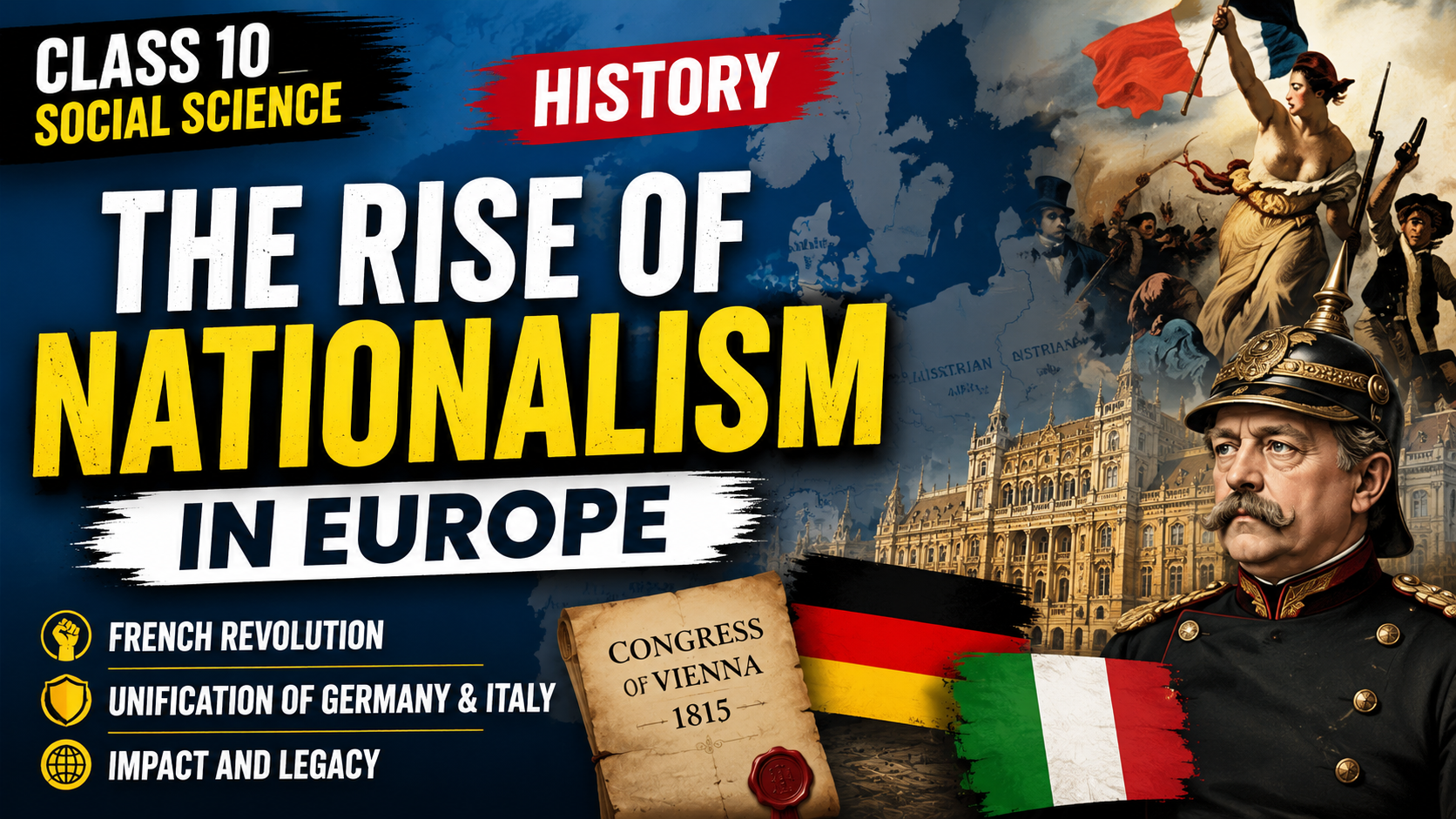
Introduction
Nationalism is a feeling of unity and patriotism among people who share common culture, language, and history. In Europe, nationalism became powerful after the French Revolution and changed the political map of Europe.
French Revolution and Nationalism
The French Revolution began in 1789 and introduced the ideas of liberty, equality, and fraternity. It ended monarchy and promoted the idea of a united nation. New symbols like the national flag, anthem, and constitution were introduced to create national identity.
Important Points
- Monarchy was abolished.
- Citizens got equal rights.
- Nationalism spread across Europe.
Napoleon and Nationalism
Napoleon Bonaparte introduced many reforms through the Napoleonic Code of 1804.
Reforms by Napoleon
- Equality before law
- End of feudal system
- Right to property
Although Napoleon spread revolutionary ideas, he later became a dictator, and many countries opposed his rule.
Congress of Vienna (1815)
After Napoleon’s defeat, European powers met in Vienna under the leadership of Metternich.
Objectives
- Restore monarchy
- Maintain balance of power
- Prevent future revolutions
This period supported conservatism but could not stop nationalism permanently.
Rise of Nationalism in Europe
Many revolutions took place in Europe between 1830 and 1848. People demanded freedom and national unity.
Greek War of Independence
Greece fought against the Ottoman Empire and became independent in 1832.
Unification of Germany
Germany was united under the leadership of Otto von Bismarck and Prussia.
Key Events
- Wars against Denmark, Austria, and France
- German unification completed in 1871
Unification of Italy
Italy was divided into many states before unification.
Important Leaders
- Giuseppe Mazzini – spread nationalist ideas
- Count Cavour – diplomatic leader
- Garibaldi – military leader
Italy became a unified nation in 1861.
Culture and Nationalism
Art, poetry, music, and folk traditions helped spread nationalism. Romantic artists inspired people to feel proud of their nation.
Nationalism and Imperialism
By the late 19th century, nationalism became aggressive and created rivalry among European nations. This later became one of the causes of World War I.
Important Dates
- 1789 – French Revolution
- 1815 – Congress of Vienna
- 1832 – Greece became independent
- 1861 – Italy unified
- 1871 – Germany unified
Conclusion
The rise of nationalism transformed Europe politically and socially. It encouraged freedom movements and led to the creation of modern nation-states like Germany and Italy.
Important Questions & Answers
The Rise of Nationalism in Europe
1. What is nationalism?
Answer:
Nationalism is a feeling of unity, pride, and devotion towards one’s nation. It develops among people who share common history, culture, language, and traditions.
2. What were the main ideas of the French Revolution?
Answer:
The French Revolution promoted:
- Liberty
- Equality
- Fraternity
It ended monarchy and spread nationalist ideas across Europe.
3. What is the Napoleonic Code?
Answer:
The Napoleonic Code was introduced by Napoleon in 1804. It:
- Established equality before law
- Abolished feudal privileges
- Protected private property
4. Who was Metternich?
Answer:
Metternich was the Austrian Chancellor who hosted the Congress of Vienna in 1815. He supported conservatism and opposed nationalism and democracy.
5. What was the Congress of Vienna?
Answer:
The Congress of Vienna was a meeting of European powers in 1815 after Napoleon’s defeat to restore monarchies and maintain balance of power in Europe.
6. Why did nationalism emerge in Europe?
Answer:
Nationalism emerged due to:
- French Revolution
- Spread of liberal ideas
- Opposition to monarchy
- Desire for national unity and freedom
7. Who led the unification of Germany?
Answer:
Otto von Bismarck, the Chief Minister of Prussia, led the unification of Germany through wars and diplomacy.
8. Name the wars fought for German unification.
Answer:
Germany fought wars against:
- Denmark
- Austria
- France
These wars helped in German unification in 1871.
9. Who were the important leaders of Italian unification?
Answer:
Important leaders were:
- Giuseppe Mazzini
- Count Cavour
- Giuseppe Garibaldi
10. What was the role of Giuseppe Mazzini?
Answer:
Mazzini was an Italian revolutionary who inspired people with nationalist ideas and worked for a united Italy.
11. How did culture help nationalism?
Answer:
Poetry, music, art, and folk traditions created feelings of unity and patriotism among people.
12. What is imperialism?
Answer:
Imperialism is the policy of extending a country’s power through colonization and military force over other nations.
13. Write two features of liberalism.
Answer:
- Freedom for individuals
- Equality before law
14. What was the main aim of conservatives?
Answer:
Conservatives wanted to preserve traditional institutions like monarchy, church, and social hierarchy.
15. When was Germany unified?
Answer:
Germany was unified in 1871.
Long Answer Questions
16. Explain the role of the French Revolution in the growth of nationalism.
Answer:
The French Revolution introduced the ideas of liberty, equality, and fraternity. It abolished monarchy and promoted the idea of nation-state. National symbols, anthem, and constitution created a sense of unity among people. These ideas inspired other European countries and spread nationalism across Europe.
17. Explain the process of Italian unification.
Answer:
Italy was divided into many states. Giuseppe Mazzini spread nationalist ideas, Count Cavour used diplomacy, and Garibaldi led military campaigns. With combined efforts, Italy became unified in 1861.
18. Describe the unification of Germany.
Answer:
Germany was earlier divided into many states. Otto von Bismarck led the process of unification through wars against Denmark, Austria, and France. After victory in these wars, Germany was unified in 1871 under Prussian leadership.