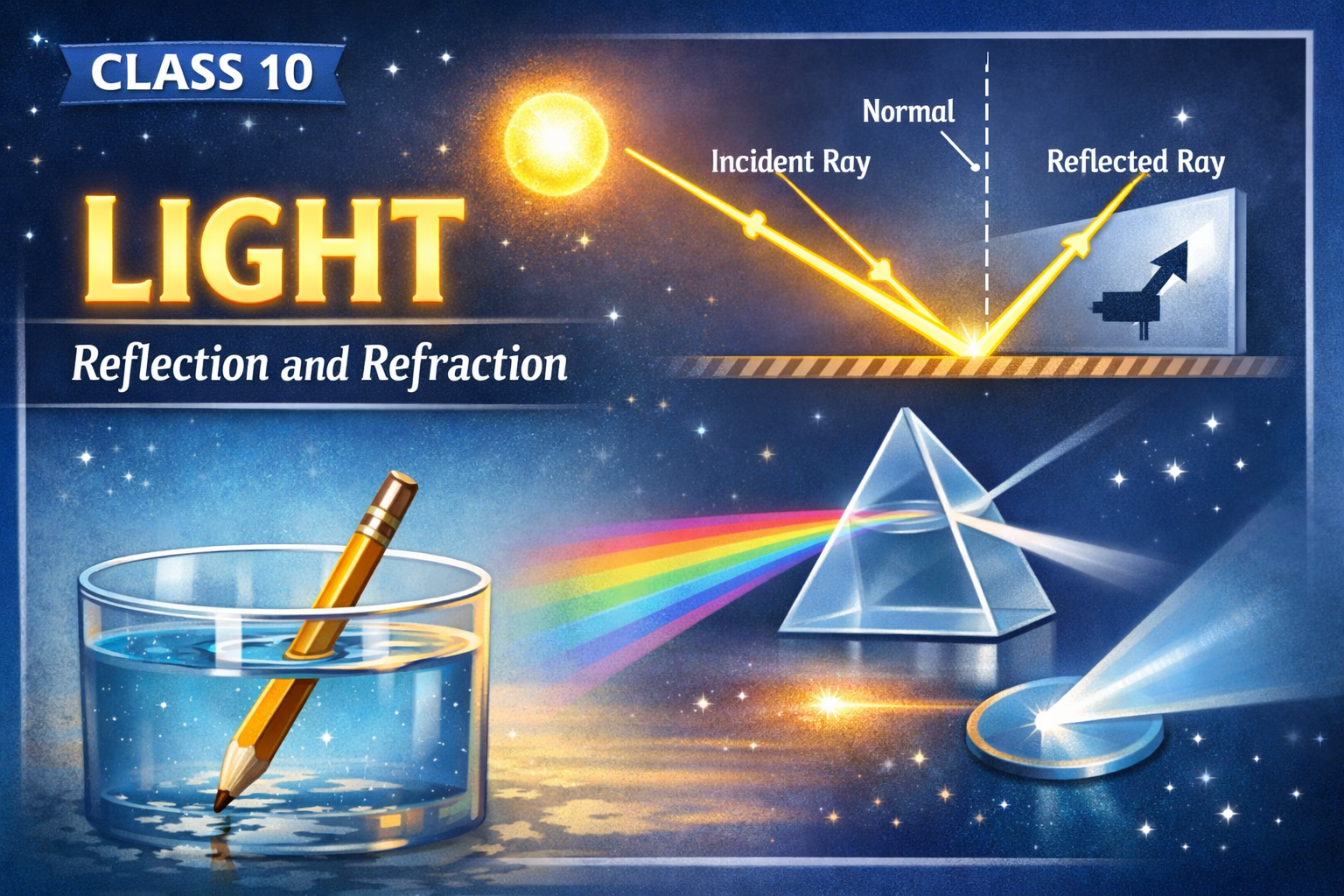
📌 Introduction
The Light – Reflection and Refraction chapter in Class 10 Science is one of the most important and scoring chapters in Physics. It builds the foundation for higher-level concepts in optics and plays a major role in board examinations. From understanding how mirrors form images to learning how lenses help us see clearly, this chapter connects science with real life in a powerful way.
Have you ever wondered:
- Why do we see our image in a mirror?
- Why does a straw appear bent in water?
- How do spectacles correct vision?
- Why are headlights concave in shape?
All these questions are answered in this fascinating chapter.
In this complete guide, we will cover:
✔ Nature of light
✔ Reflection of light
✔ Spherical mirrors
✔ Image formation by mirrors
✔ Refraction of light
✔ Lenses and image formation
✔ Important formulas
✔ Sign conventions
✔ Real-life applications
✔ Board exam preparation tips
🌞 1. Nature of Light
Light is a form of energy that enables us to see objects. It travels in straight lines and moves extremely fast.
Important Facts:
- Speed of light in vacuum = 3 × 10⁸ m/s
- Light travels in straight lines (Rectilinear propagation)
- Light can undergo:
- Reflection
- Refraction
- Dispersion
Light does not require a material medium to travel. That is why sunlight reaches Earth through space.
🔁 2. Reflection of Light
What is Reflection?
Reflection is the bouncing back of light when it strikes a polished surface like a mirror.
When a ray of light hits a mirror:
- Some light is absorbed
- Some is reflected back
📏 Laws of Reflection
There are two laws of reflection:
- The angle of incidence (∠i) is equal to the angle of reflection (∠r).
- The incident ray, reflected ray, and the normal lie in the same plane.
These laws are always followed, no matter what type of mirror is used.
🪞 3. Types of Mirrors
Mirrors are of two main types:
- Plane Mirrors
- Spherical Mirrors
🟢 Plane Mirror
A flat mirror is called a plane mirror.
Characteristics of Image Formed:
- Virtual and erect
- Same size as object
- Laterally inverted
- Image distance = Object distance
Example: Bathroom mirrors.
🔵 Spherical Mirrors
Spherical mirrors are curved mirrors.
They are of two types:
- Concave Mirror
- Convex Mirror
🪞 Concave Mirror
A concave mirror curves inward.
Uses:
- Shaving mirror
- Dentist mirror
- Torch reflectors
- Headlights
Image Formation:
- Can form real & inverted images
- Can form virtual & erect image (when object is between pole and focus)
🚗 Convex Mirror
A convex mirror curves outward.
Uses:
- Rear-view mirrors in vehicles
- Security mirrors
Image Formation:
- Always forms virtual, erect, and diminished images
📍 4. Important Terms in Spherical Mirrors
You must understand these terms:
- Pole (P): Center of mirror surface
- Principal Axis: Straight line through pole and center
- Center of Curvature (C): Center of sphere
- Radius of Curvature (R): Distance between P and C
- Principal Focus (F): Point where parallel rays meet
Relationship:
R = 2f
📐 5. Mirror Formula
The mirror formula is:
🌊 6. Refraction of Light
What is Refraction?
Refraction is the bending of light when it passes from one medium to another.
Example:
- Air → Water
- Air → Glass
Why Does Refraction Occur?
Because the speed of light changes in different mediums.
Speed in air > Speed in water
Speed in water > Speed in glass
📏 Laws of Refraction
- The incident ray, refracted ray, and normal lie in the same plane.
- Snell’s Law:
Sin i /sin r = constant
This constant is called refractive index.
🔬 7. Refractive Index
Refractive index (n) or index of refraction, is a dimensionless number that describes how light propagates through a medium.
n=c\v
🔍 8. Refraction Through Glass Slab
Important observations:
- Ray bends towards normal (entering glass)
- Ray bends away from normal (leaving glass)
- Emergent ray is parallel to incident ray
👓 9. Lenses
Lenses are transparent materials that refract light.
Two types:
- Convex Lens
- Concave Lens
🔵 Convex Lens
- Converging lens
- Thicker in middle
- Forms real and inverted images
- Used in:
- Magnifying glass
- Camera
- Projector
🔴 Concave Lens
- Diverging lens
- Thinner in middle
- Always forms virtual, erect image
- Used in:
- Spectacles for myopia
📐 10. Lens Formula
👁 11. Human Eye and Power of Lens
Our eye contains a convex lens.
Common defects:
- Myopia (Short-sightedness)
- Hypermetropia (Long-sightedness)
Correction:
- Myopia → Concave lens
- Hypermetropia → Convex lens
Power of lens:
Unit: Dioptre (D)
📊 12. Real vs Virtual Image
| Real Image | Virtual Image |
| Formed by actual rays | Formed by apparent rays |
| Can be obtained on screen | Cannot be obtained on screen |
| Inverted | Erect |
🎯 13. Important Board Questions
- State laws of reflection
- Draw ray diagram for concave mirror
- Derive mirror formula
- What is refractive index?
- Explain myopia and correction
Practice numericals regularly.
🧠 14. Exam Preparation Strategy
✔ Learn definitions clearly
✔ Draw neat ray diagrams
✔ Revise formulas daily
✔ Practice previous year questions
✔ Understand sign convention
🌟 15. Real-Life Applications of Light
- Solar cookers
- Optical fibers
- Cameras
- Spectacles
- Telescopes
- Microscopes
Light is everywhere in technology.
🏁 Conclusion
The Light chapter is not just about formulas and diagrams — it is about understanding how we see the world. From simple mirrors to complex optical instruments, reflection and refraction explain many daily-life phenomena.
If you understand concepts deeply and practice diagrams regularly, you can easily score full marks in this chapter.
Consistency + Practice + Revision = Success.