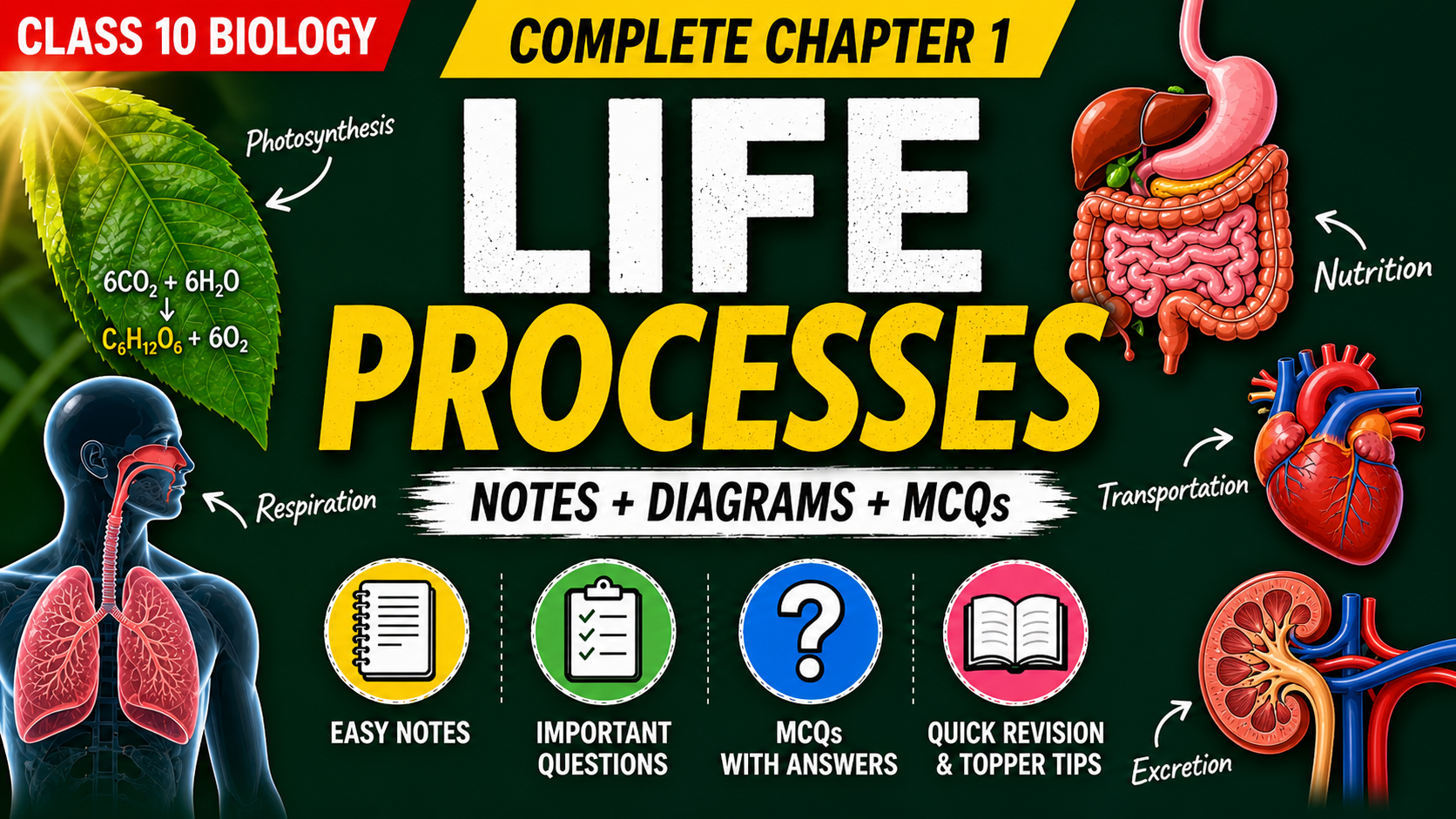
🔹 What are Life Processes?
Life processes are the basic functions performed by living organisms to maintain life.
Main Life Processes:
- Nutrition
- Respiration
- Transportation
- Excretion
🍎 1. Nutrition
🔹 Definition:
The process by which organisms obtain and use food.
🔹 Types of Nutrition:
1. Autotrophic Nutrition
- Organisms make their own food.
- Example: Plants
🌿 Photosynthesis:
- Process by which plants make food using sunlight.
Equation:6CO2+6H2Osunlight+chlorophyllC6H12O6+6O2
2. Heterotrophic Nutrition
- Organisms depend on others for food.
Types:
- Holozoic (Humans, animals)
- Saprophytic (Fungi)
- Parasitic (Leech)
🍽️ Human Digestive System
Steps:
- Ingestion
- Digestion
- Absorption
- Assimilation
- Egestion
Important Organs:
- Mouth (saliva, amylase)
- Stomach (HCl, pepsin)
- Small intestine (digestion + absorption)
- Liver (bile)
- Pancreas (enzymes)
🌬️ 2. Respiration
🔹 Definition:
Process of breaking down food to release energy.
🔹 Types:
1. Aerobic Respiration
- Uses oxygen
- Produces more energy
Glucose+O2→CO2+H2O+Energy
2. Anaerobic Respiration
- Without oxygen
- Less energy
🔹 Human Respiratory System:
- Nose → Trachea → Bronchi → Lungs → Alveoli
🔸 Alveoli:
- Site of gas exchange
- Large surface area
🚚 3. Transportation
🔹 In Humans:
❤️ Blood:
- RBC → oxygen transport
- WBC → immunity
- Platelets → clotting
❤️ Heart:
- 4 chambers:
- Right atrium
- Right ventricle
- Left atrium
- Left ventricle
🔄 Double Circulation:
- Blood passes twice through heart
🔹 In Plants:
Transport Tissues:
- Xylem → water
- Phloem → food
🚽 4. Excretion
🔹 Definition:
Removal of waste products.
🔹 Human Excretory System:
- Kidneys
- Ureters
- Urinary bladder
- Urethra
🔸 Nephron:
- Basic unit of kidney
Steps:
- Filtration
- Reabsorption
- Urine formation
🔹 In Plants:
- Waste removed by:
- Leaves
- Bark
- Stomata
⭐ Important Points (Exam Tips)
- Photosynthesis occurs in chloroplast
- Alveoli increase surface area
- Heart shows double circulation
- Nephron is functional unit of kidney
- Xylem & phloem are transport tissues
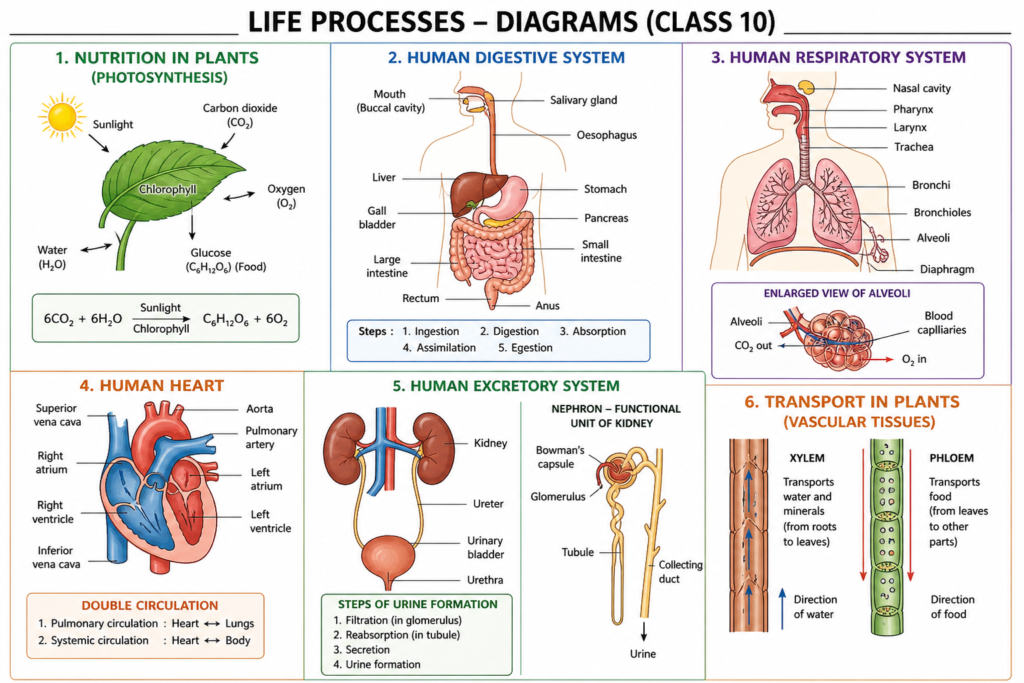
Diagrams (very useful for exams)
🧠 MCQs – Life Processes
🔹 1. Nutrition
Q1. Which process is used by plants to make food?
A) Respiration
B) Photosynthesis
C) Transpiration
D) Digestion
👉 Answer: B) Photosynthesis
Q2. Which gas is taken in during photosynthesis?
A) Oxygen
B) Nitrogen
C) Carbon dioxide
D) Hydrogen
👉 Answer: C) Carbon dioxide
Q3. Chlorophyll is present in:
A) Mitochondria
B) Nucleus
C) Chloroplast
D) Ribosome
👉 Answer: C) Chloroplast
Q4. Heterotrophic nutrition includes:
A) Autotrophs
B) Saprophytes
C) Producers
D) Plants
👉 Answer: B) Saprophytes
🍽️ 2. Digestion
Q5. Where does digestion of protein begin?
A) Mouth
B) Stomach
C) Small intestine
D) Large intestine
👉 Answer: B) Stomach
Q6. Which enzyme is present in saliva?
A) Pepsin
B) Trypsin
C) Amylase
D) Lipase
👉 Answer: C) Amylase
Q7. The main site of absorption is:
A) Stomach
B) Small intestine
C) Large intestine
D) Mouth
👉 Answer: B) Small intestine
🌬️ 3. Respiration
Q8. Aerobic respiration occurs in presence of:
A) Nitrogen
B) Oxygen
C) Carbon dioxide
D) Hydrogen
👉 Answer: B) Oxygen
Q9. Which organ helps in breathing?
A) Heart
B) Kidney
C) Lungs
D) Liver
👉 Answer: C) Lungs
Q10. Gas exchange occurs in:
A) Trachea
B) Bronchi
C) Alveoli
D) Nose
👉 Answer: C) Alveoli
🚚 4. Transportation
Q11. Which part pumps blood?
A) Brain
B) Lungs
C) Heart
D) Kidney
👉 Answer: C) Heart
Q12. RBC carries:
A) CO₂
B) Oxygen
C) Hormones
D) Enzymes
👉 Answer: B) Oxygen
Q13. Which vessel carries blood away from heart?
A) Veins
B) Arteries
C) Capillaries
D) Lymph
👉 Answer: B) Arteries
🌿 5. Transport in Plants
Q14. Xylem transports:
A) Food
B) Water
C) Oxygen
D) Hormones
👉 Answer: B) Water
Q15. Phloem transports:
A) Water
B) Minerals
C) Food
D) Oxygen
👉 Answer: C) Food
🚽 6. Excretion
Q16. Functional unit of kidney is:
A) Neuron
B) Nephron
C) Alveoli
D) Villus
👉 Answer: B) Nephron
Q17. Urine is stored in:
A) Kidney
B) Ureter
C) Urinary bladder
D) Urethra
👉 Answer: C) Urinary bladder
🔥 Mixed Concept Questions
Q18. Double circulation means:
A) Blood flows once
B) Blood flows twice through heart
C) Blood flows in one direction
D) No circulation
👉 Answer: B
Q19. Which process releases energy?
A) Photosynthesis
B) Respiration
C) Digestion
D) Excretion
👉 Answer: B) Respiration
Q20. Which organ removes nitrogenous waste?
A) Heart
B) Lungs
C) Kidney
D) Liver
👉 Answer: C) Kidney
🧪 CASE 1: Photosynthesis
A student kept two plants—one in sunlight and one in a dark room. After a few days, the plant in sunlight remained healthy, while the other showed poor growth.
Q1. Why did the plant in darkness show poor growth?
A) Lack of oxygen
B) Lack of water
C) No photosynthesis
D) Excess minerals
👉 Answer: C) No photosynthesis
Q2. Which raw material was unavailable in the dark?
A) CO₂
B) Water
C) Sunlight
D) Chlorophyll
👉 Answer: C) Sunlight
Q3. What is the role of chlorophyll?
A) Absorbs CO₂
B) Absorbs sunlight
C) Produces oxygen
D) Absorbs water
👉 Answer: B) Absorbs sunlight
🍽️ CASE 2: Digestion
Rahul eats a heavy meal rich in proteins. His stomach secretes digestive juices to break down food.
Q4. Which enzyme helps in protein digestion in stomach?
A) Amylase
B) Lipase
C) Pepsin
D) Trypsin
👉 Answer: C) Pepsin
Q5. What is the role of HCl in stomach?
A) Neutralizes acid
B) Kills bacteria & activates enzymes
C) Digests fats
D) Absorbs nutrients
👉 Answer: B)
Q6. Where is most digestion completed?
A) Mouth
B) Stomach
C) Small intestine
D) Large intestine
👉 Answer: C)
🌬️ CASE 3: Respiration
During exercise, a person breathes faster and feels tired due to increased energy demand.
Q7. Why does breathing rate increase?
A) To remove nitrogen
B) To supply more oxygen
C) To reduce heart rate
D) To digest food
👉 Answer: B)
Q8. Where does gas exchange occur?
A) Trachea
B) Bronchi
C) Alveoli
D) Nose
👉 Answer: C)
Q9. Which gas is released during respiration?
A) Oxygen
B) Nitrogen
C) Carbon dioxide
D) Hydrogen
👉 Answer: C)