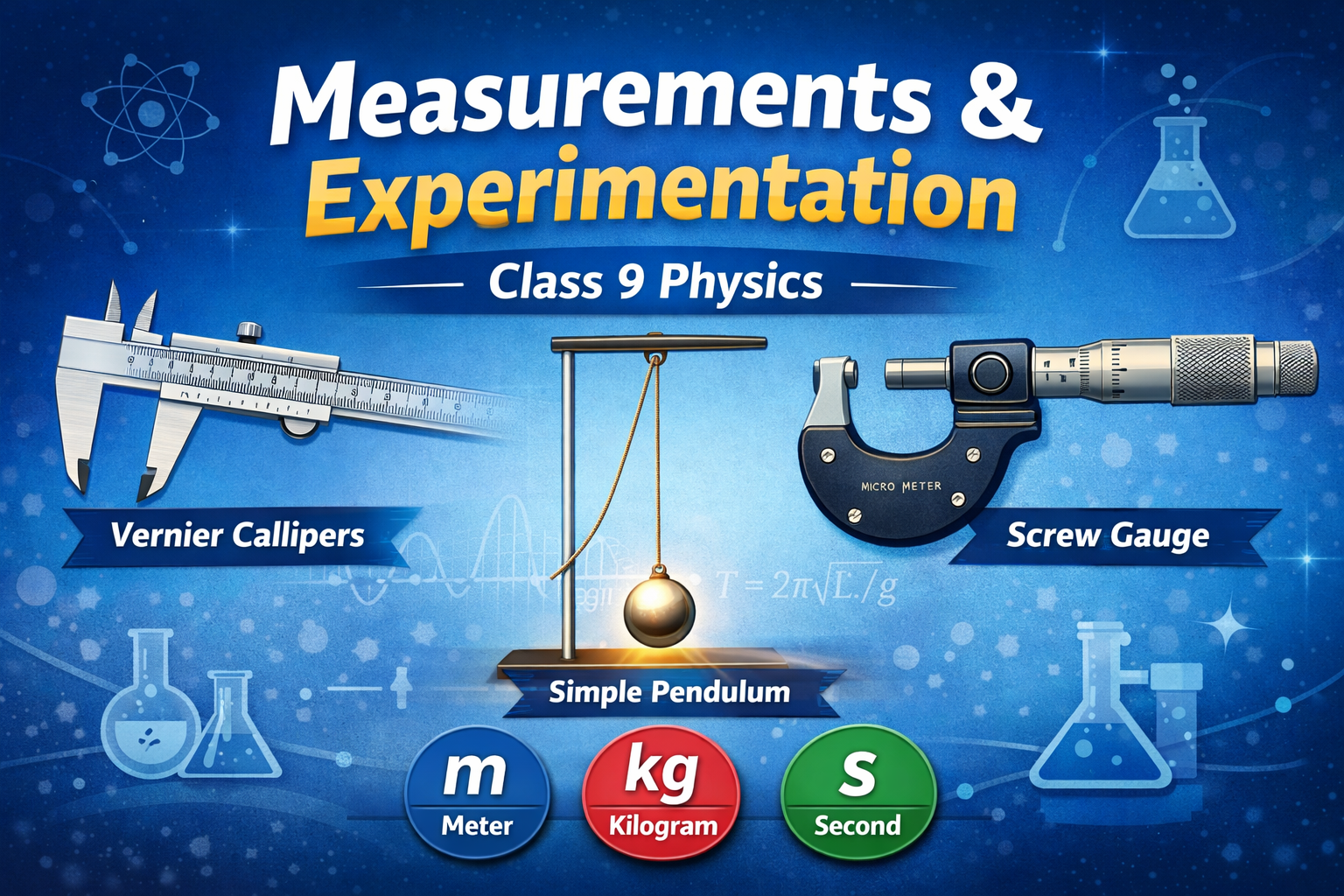
Learn Class 9 Physics Measurements and Experimentation chapter with simple explanations of SI Units, Vernier Callipers, Micrometer Screw Gauge, and Simple Pendulum experiment. Perfect guide for ICSE and CBSE students.
Measurements and Experimentation – Class 9 Physics Complete Guide
Measurement is one of the most important parts of science. In physics, we must measure different quantities like length, mass, and time to understand natural phenomena and perform experiments correctly. The chapter Measurements and Experimentation helps students learn how scientists measure physical quantities and how different instruments are used in laboratories.
In this article, we will understand the International System of Units (SI Units), different measurement systems, and common instruments used for accurate measurement.
What is Measurement?
Measurement is the process of comparing an unknown quantity with a known standard unit. For example, when we measure the length of a table using a ruler, we are comparing it with the standard unit of length called a meter.
Without measurement, scientific experiments would not be reliable or repeatable. Accurate measurement helps scientists record data and draw correct conclusions.
Systems of Units
A system of units is a set of standard units used to measure physical quantities. There are several systems of units used in science.
1. SI System (International System of Units)
The SI system is the most widely used system of measurement in the world. It is used in science, engineering, and daily life.
Important SI Units include:
| Physical Quantity | SI Unit | Symbol |
| Length | metre | m |
| Mass | kilogram | kg |
| Time | second | s |
| Temperature | kelvin | K |
| Electric Current | ampere | A |
The International System of Units provides a universal standard so that scientists across the world can communicate measurements easily.
2. CGS System
CGS stands for Centimeter–Gram–Second system.
| Physical Quantity | Unit |
| Length | centimeter |
| Mass | gram |
| Time | second |
This system was widely used earlier in physics experiments but is now mostly replaced by the SI system.
3. FPS System
FPS stands for Foot–Pound–Second system.
| Physical Quantity | Unit |
| Length | foot |
| Mass | pound |
| Time | second |
This system is mainly used in some engineering applications.
Measuring Length Using Instruments
For accurate measurements, scientists use special instruments. Two important instruments used to measure small lengths are:
Vernier Callipers
Vernier Callipers is a precision instrument used to measure small lengths, internal diameters, external diameters, and depths.
Main Parts
- Main scale
- Vernier scale
- Jaws
- Depth rod
Uses
- Measuring diameter of a coin
- Measuring internal diameter of a tube
- Measuring depth of a container
Vernier callipers provide more accurate measurements than a simple ruler.
Micrometer Screw Gauge
Another important instrument is the Micrometer Screw Gauge. It is used to measure very small thickness or diameter.
Main Parts
- Frame
- Anvil
- Spindle
- Sleeve
- Thimble
Uses
- Measuring thickness of paper
- Measuring diameter of a thin wire
- Measuring thickness of metal sheets
The screw gauge works on the principle of a screw mechanism, allowing very precise measurement.
Measurement of Time Using Simple Pendulum
Time can also be measured through experiments. One common experiment uses a Simple Pendulum.
A simple pendulum consists of a small metal bob suspended from a fixed point using a thread.
Pendulum Experiment
In this experiment, the pendulum is allowed to swing freely.
The time period of the pendulum is defined as the time taken to complete one full oscillation.
Formula:
T=Total TimeNumber of OscillationsT = \frac{Total\ Time}{Number\ of\ Oscillations}T=Number of OscillationsTotal Time
Students often perform this experiment in school laboratories to understand the concept of periodic motion.
Importance of Accurate Measurements
Accurate measurements are essential in science because small errors can lead to incorrect results.
There are several types of errors in measurement:
- Instrument Error – due to faulty instruments
- Human Error – due to incorrect reading
- Environmental Error – due to temperature or surroundings
To reduce errors, scientists take multiple readings and calculate the average value.
Conclusion
Measurements play a crucial role in physics experiments. The use of standard units like those in the SI system ensures consistency in scientific communication across the world.
In this chapter, students learn about different systems of units and how instruments such as Vernier callipers, micrometer screw gauge, and simple pendulum are used to measure physical quantities accurately.
Understanding these concepts helps students develop practical scientific skills and prepares them for laboratory experiments in higher classes.