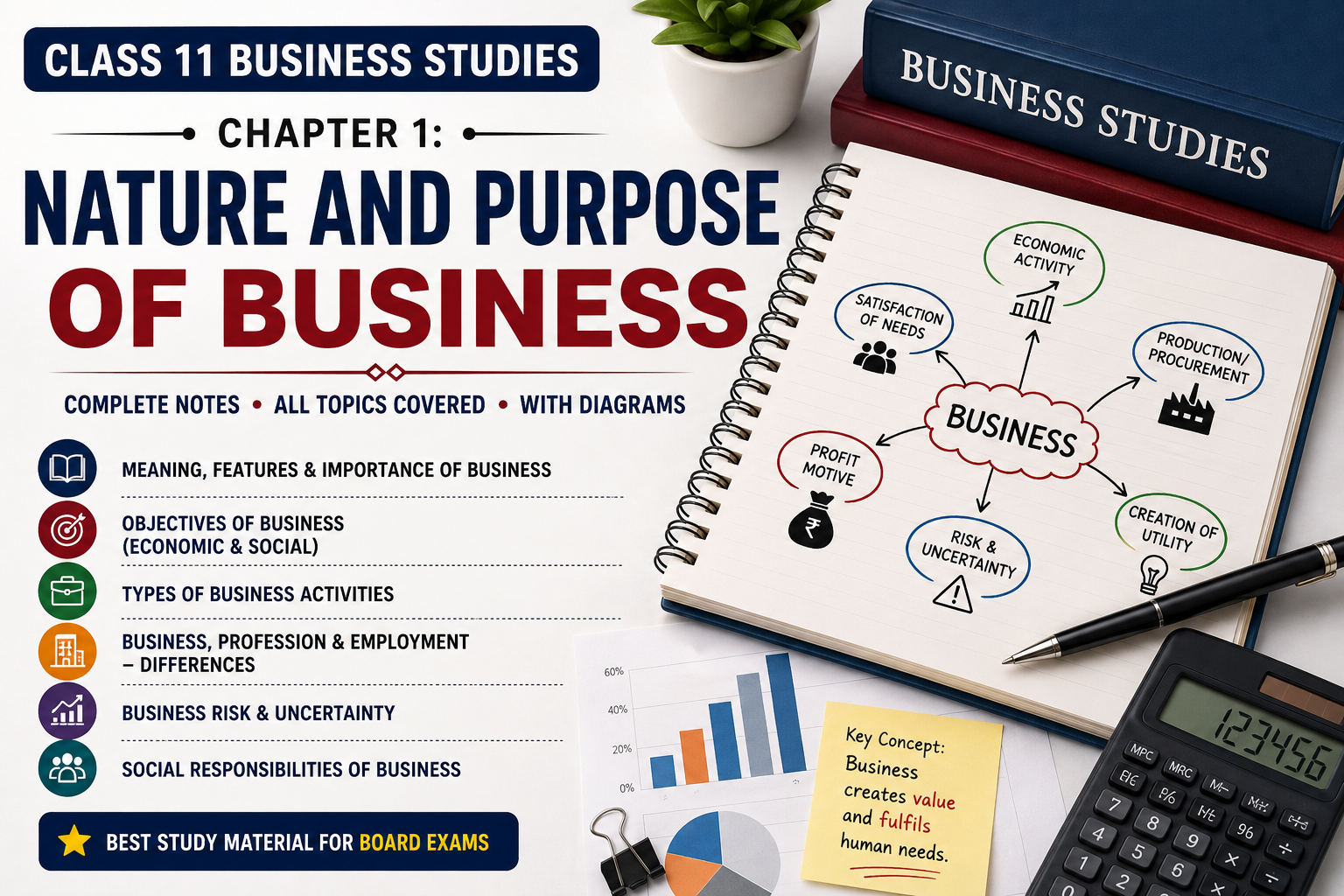

Chapter 1: Nature and Purpose of Business
Human Activities – Economic & Non-Economic
Human activities are broadly classified into two types based on their motive:
Economic Activities
- Performed for earning money or livelihood
- Have monetary value and rewards
- Examples: Business, Employment, Profession
- Motive: Economic gain / profit
Non-Economic Activities
- Performed out of love, patriotism, emotion
- No monetary reward involved
- Examples: Charity, Helping family, Religious work
- Motive: Social, psychological, emotional satisfaction
The same activity can be economic or non-economic depending on the motive. E.g., a doctor treating a patient for money = Economic; treating for charity = Non-economic.
Business – Meaning and Definition
"Business refers to an economic activity involving the production or purchase of goods and the sale or exchange of goods and services with the motive of earning profit."
Essential Characteristics of Business
- Economic Activity: Business is undertaken for economic gain, not for personal satisfaction or charity.
- Production or Purchase of Goods: Goods must be produced or purchased before they can be sold.
- Sale or Exchange of Goods and Services: Transfer of goods/services for value is essential; personal use is not business.
- Regularity of Dealings: A single transaction does not constitute business; there must be regularity.
- Profit Motive: Earning profit is the primary objective (though not the only one in modern business).
- Uncertainty of Return / Business Risk: Future profit is never guaranteed; risk is inherent.
- Satisfaction of Human Wants: Business serves society by fulfilling consumer needs.
Concept of Business
The concept of business has evolved from a narrow profit-only view to a broader socio-economic perspective:
- Traditional Concept: Business = buying and selling goods for profit. Customer satisfaction was secondary.
- Modern Concept: Business = satisfying customer needs profitably while contributing to social welfare.
- Systems Approach: Business is a system that takes inputs (resources) and transforms them into outputs (goods/services) for society.
Today, business is seen as a social institution with responsibilities towards customers, employees, shareholders, and society at large — not just profit-making.
Characteristics of Business
- Economic Activity: Involves production, distribution, or exchange for monetary gain.
- Continuity: Business is a continuous and regular process, not a one-time activity.
- Profit Motive: The primary driving force behind starting and operating a business.
- Creation of Utility: Creates form utility (manufacturing), place utility (transport), time utility (storage), and possession utility (trading).
- Risk and Uncertainty: Business always involves risk of loss due to changing market conditions.
- Consumer Satisfaction: Modern businesses focus on meeting consumer needs to survive and grow.
- Social Obligation: Business has duties towards society, including environmental care and ethical practices.
Nature of Business
The nature of business can be understood from multiple dimensions:
As a Profession
- Requires specialized knowledge & skills
- Has professional bodies (e.g., ICAI)
- Regulated by code of conduct
As an Occupation
- Provides livelihood and income
- Involves regular economic activity
- Can be self-employment or service
Business in its nature is dynamic (changes with environment), goal-oriented (profit + social goals), and organised (systematic use of resources).
Business, Profession and Employment – Meaning & Differences
Profession: An occupation requiring specialized knowledge, training, and often governed by a professional body. E.g., Doctor, Lawyer, CA.
Employment: An economic activity where a person works under a contract of service (employer-employee) and earns a fixed salary or wage.
Difference between Business, Profession and Employment
| Basis | Business | Profession | Employment |
|---|---|---|---|
| Nature | Production/exchange of goods & services | Rendering personal services | Working under employer |
| Qualification | Not compulsorySpecialized degree essential | As per job requirement | |
| Return | Profit (uncertain) | Professional fee (variable) | Salary/Wages (fixed) |
| Capital | Required (varies) | Moderate | Not required |
| Risk | High (profit not guaranteed) | Moderate | Low / Nil |
| Code of Conduct | No rigid code | Strictly regulated | As per employment terms |
| Transfer | Possible | Not possible | Not possible |
Objectives of Business
Economic Objectives
- Earning profit
- Creation of customers
- Innovation and technological improvement
- Optimum utilization of resources
Social Objectives
- Supply of quality goods at fair prices
- Employment generation
- Fair wages and safe working conditions
- Environmental protection
Human Objectives
- Employee welfare and development
- Fair remuneration and job satisfaction
- Development of human resources
- Respect for human dignity
National Objectives
- Contribute to national income (GDP)
- Support economic development
- Self-sufficiency in production
- Foreign exchange earnings
Employment – Meaning and Definitions
"Employment refers to an occupation in which a person works regularly for another and receives remuneration (salary/wages) in return."
Key Features of Employment
- Employer-Employee Relationship: Legal contract (service agreement) governs the relationship.
- Fixed Remuneration: Salary or wages are agreed upon and paid regularly.
- No Risk: Employee doesn't bear financial risk of the business.
- Service Conditions: Governed by labor laws, company policies, and employment contract.
- Security: Job security and assured income make employment desirable for many.
Business Risks – Meaning and Causes
"Business risk refers to the possibility of inadequate profits or even losses due to uncertainties and unexpected events in the business environment."
Causes of Business Risk
- Natural Causes: Floods, earthquakes, droughts, fire — uncontrollable natural disasters causing loss.
- Human Causes: Dishonesty of employees, strikes, riots, accidents, mismanagement.
- Economic Causes: Fluctuations in demand/supply, price changes, inflation, recession, competition.
- Physical Causes: Mechanical failures, power cuts, technology obsolescence.
- Other Causes: Changes in government policy, political instability, social unrest.
Risk is an inseparable part of business. The greater the risk taken, the greater the potential reward. Risk can be minimized but never completely eliminated.
Nature of Business Risks
- Business Risk Arises Due to Uncertainties: Future is uncertain; no one can predict demand, prices, or competition with 100% accuracy.
- Risk is an Essential Part of Every Business: Starting or running a business always involves risk; it cannot be avoided.
- Degree of Risk Depends on Nature and Size: A large business may face more risk (more capital at stake) but also has more resources to absorb shocks.
- Profit is the Reward for Risk-Bearing: Entrepreneurs take risks; profit is their compensation. Higher risk → potential for higher profit.
- Risk Can Be Minimized: Through insurance, market research, diversification, and sound management practices.
XI Causes of Business Risk (Detailed)
Internal Causes
- Poor management decisions
- Labor disputes and strikes
- Machine breakdowns
- Employee dishonesty or fraud
- Lack of innovation
External Causes
- Market fluctuations (demand/price)
- Government policy changes
- Natural calamities
- Political instability
- Technological changes
Role of Profit in Business
Profit plays a crucial multi-dimensional role in business:
- Reward for Risk: Profit compensates entrepreneurs for taking financial and operational risks.
- Source of Finance: Retained profits fund expansion, R&D, and modernization without external borrowing.
- Indicator of Efficiency: Consistent profits signal sound management and efficient use of resources.
- Survival and Growth: A business cannot survive long-term without profit; it funds daily operations and future growth.
- Motivation: Profit motivates owners, managers, and employees to perform better.
- Social Benefit: Profitable businesses pay more taxes, create more jobs, and contribute more to economic development.
No. Modern business thinkers argue that businesses should pursue optimum profit — not maximum profit — while fulfilling social, ethical, and legal obligations. Pure profit-maximization leads to exploitation and social unrest.
Nature of Business Risks & Risk Minimisation
Methods to Minimise Business Risk
- Insurance: Insure assets and business against fire, theft, flood, liability, etc.
- Market Research: Study consumer behaviour, trends, and competition before launching products.
- Diversification: Spread business across multiple products/markets to reduce dependence on one.
- Sound Financial Planning: Maintain adequate working capital; avoid over-leveraging.
- Building Reserves: Keep aside profits as reserves to absorb unexpected losses.
- Training and Development: Well-trained employees reduce operational errors and increase efficiency.
- Contingency Planning: Plan for unexpected situations (power outages, supply disruptions, etc.).