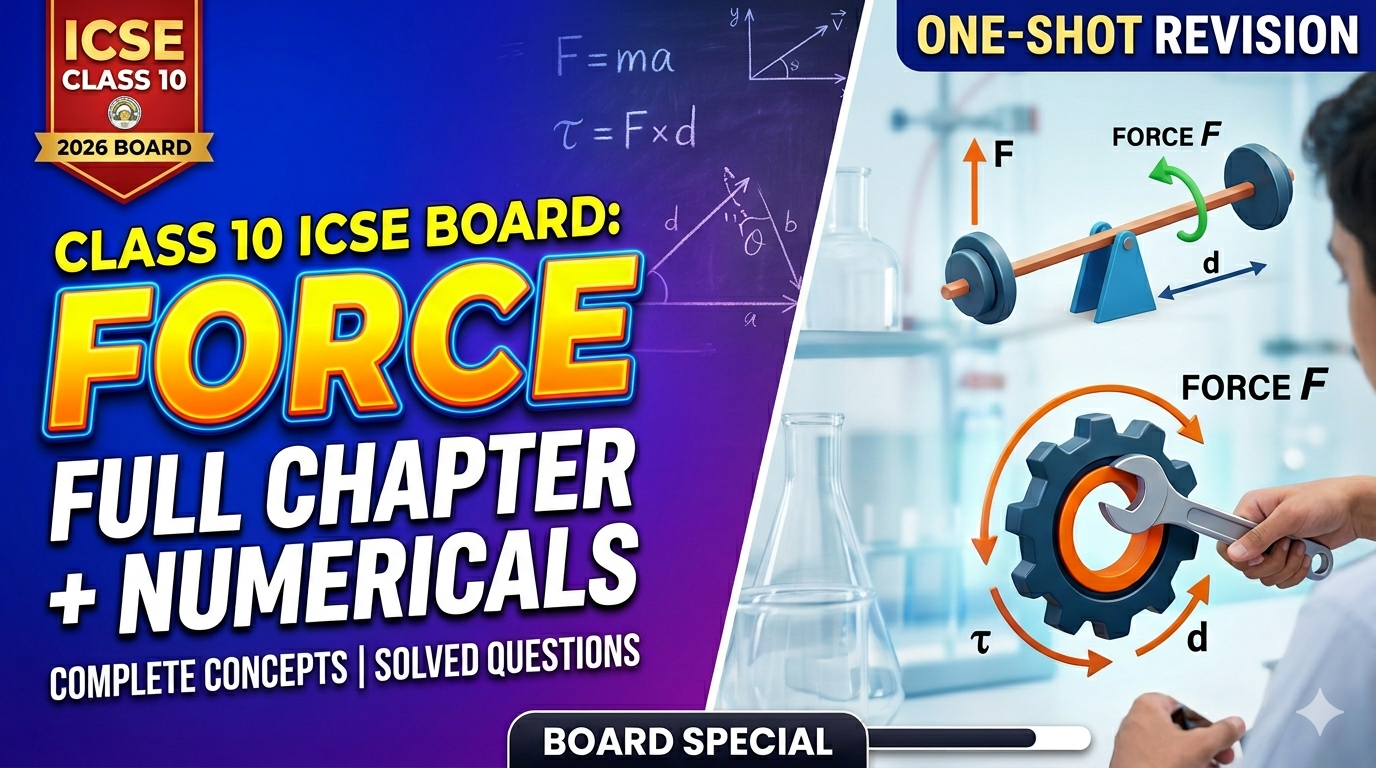
Force is one of the most important concepts in physics. In ICSE Board Class 10 Physics, the topic of force helps students understand how objects move and interact with each other.
From pushing a door to launching rockets, force plays a crucial role in everyday life. Understanding this concept helps students learn about motion, acceleration, and many real-world applications.
What is Force?
Force can be defined as a push or pull acting on an object that can change its state of motion or shape.
In simple words, whenever we push, pull, lift, or throw an object, we are applying force.
Examples of Force
- Pushing a table across the floor
- Pulling a rope during tug-of-war
- Kicking a football
- Opening or closing a door
Force can change:
- Speed of an object
- Direction of motion
- Shape or size of an object
SI Unit of Force
The SI unit of force is Newton (N).
This unit is named after the famous scientist Isaac Newton, who discovered the laws of motion.
Formula of Force
Force is calculated using the formula:
F = m × a
Where:
- F = Force
- m = Mass
- a = Acceleration
This formula shows that the force acting on an object depends on its mass and acceleration.
Effects of Force
Force can produce several effects on objects. These include:
1. Changing the State of Motion
Force can make a stationary object move.
Example: Pushing a stationary cart.
2. Stopping a Moving Object
Applying force can stop a moving object.
Example: Applying brakes to stop a bicycle.
3. Changing the Direction of Motion
Force can change the direction in which an object moves.
Example: Hitting a cricket ball with a bat.
4. Changing Shape or Size
Force can change the shape of an object.
Example: Stretching a rubber band.
Types of Forces
Forces are mainly classified into two types:
1. Contact Forces
Contact forces act when two objects are physically touching each other.
Muscular Force
Muscular force is produced by the muscles of humans or animals.
Examples:
- Lifting a bag
- Pushing furniture
Frictional Force
Friction is the force that opposes the motion of objects when two surfaces are in contact.
Examples:
- A book sliding on a table slows down due to friction.
2. Non-Contact Forces
Non-contact forces act without direct physical contact between objects.
Gravitational Force
This is the force with which the Earth attracts objects towards its center.
Example:
- When we drop a ball, it falls to the ground due to gravity.
Magnetic Force
Magnetic force is the force exerted by magnets.
Example:
- A magnet attracting iron nails.
Electrostatic Force
This force occurs between electrically charged objects.
Example:
- A rubbed balloon attracting small pieces of paper.
Balanced and Unbalanced Forces
Understanding balanced and unbalanced forces is very important in physics.
Balanced Forces
Balanced forces occur when two forces acting on an object are equal in magnitude but opposite in direction.
In this case, the object remains at rest or continues moving at constant speed.
Example:
A book lying on a table experiences gravitational force downward and normal force upward.
Unbalanced Forces
Unbalanced forces occur when the forces acting on an object are not equal.
This causes the object to accelerate or move.
Example:
When a football is kicked, it moves because of an unbalanced force.
Newton’s Laws of Motion
The study of force becomes clearer when we understand the laws of motion given by Isaac Newton.
These laws explain how forces affect motion.
First Law of Motion (Law of Inertia)
This law states that:
An object will remain at rest or in uniform motion unless acted upon by an external force.
Example:
Passengers move forward when a bus stops suddenly.
Second Law of Motion
This law explains the relationship between force, mass, and acceleration.
It states that:
The force acting on an object is equal to the product of its mass and acceleration.
Formula:
F = m × a
This law helps calculate the amount of force needed to move objects.
Third Law of Motion
This law states:
For every action, there is an equal and opposite reaction.
Example:
When a rocket is launched, gases are pushed downward and the rocket moves upward.
Importance of Force in Daily Life
Force is involved in almost every activity we perform. Some daily examples include:
- Walking
- Driving vehicles
- Playing sports
- Lifting objects
- Opening doors
Without force, movement would not be possible.
Understanding force helps students build a strong foundation for higher studies in physics and engineering.
Conclusion
Force is a fundamental concept in Class 10 ICSE Physics. It explains how objects move and interact with each other. By learning about the types of forces, balanced and unbalanced forces, and Newton’s laws of motion, students gain a clear understanding of how physical systems work.
Mastering this topic not only helps in examinations but also improves understanding of real-world phenomena.
Students preparing for the ICSE Class 10 board exam should practice numerical problems and conceptual questions related to force to strengthen their knowledge.