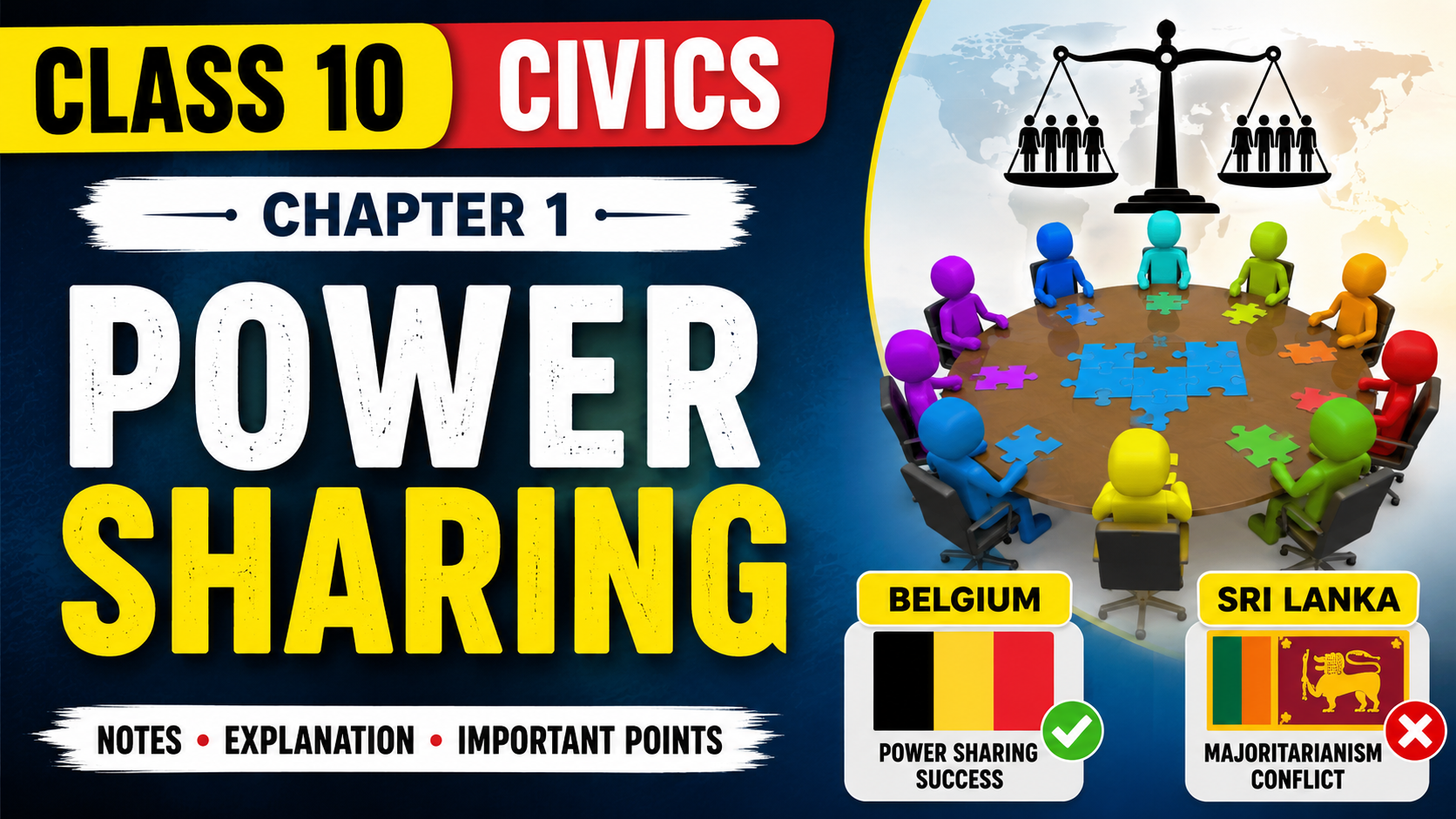
Introduction to Power Sharing
Power sharing is one of the most important features of a democratic country. In democracy, power should not remain in the hands of one person or one group. It should be shared among different groups, communities, and institutions so that everyone gets equal participation in governance.
The chapter “Power Sharing” explains why sharing power is necessary for maintaining peace, unity, and stability in society. It also discusses how countries like Belgium and Sri Lanka handled issues related to ethnic diversity.
What is Power Sharing?
Power sharing means distribution of power among different organs, levels, and groups of society.
It ensures:
- Political stability
- Equality among citizens
- Better decision-making
- Reduction in conflicts
- Respect for diversity
In a democratic system, people have the right to participate in governance.
Why is Power Sharing Important?
1. Prudential Reason
Prudential reasons focus on practical benefits.
Power sharing:
- Reduces social conflicts
- Prevents violence
- Maintains political stability
- Ensures unity of the country
Example: Belgium successfully adopted power sharing and avoided civil war.
2. Moral Reason
Moral reasons emphasize democracy and equality.
Power sharing:
- Respects the spirit of democracy
- Gives citizens the right to participate
- Ensures fairness
- Protects minority rights
Democracy is based on the idea that people are the real source of power.
Story of Belgium
Belgium is a small European country with a diverse population.
Population Composition
- 59% Dutch-speaking people
- 40% French-speaking people
- 1% German-speaking people
In the capital city Brussels:
- 80% French-speaking
- 20% Dutch-speaking
This diversity created tensions between communities.
Belgian Model of Power Sharing
Belgium adopted several measures to avoid conflict:
Key Features
1. Equal Representation
The constitution provided equal representation to Dutch and French-speaking ministers.
2. Separate Government for Communities
Special community governments were created for:
- Dutch community
- French community
- German community
These governments handled:
- Culture
- Education
- Language-related issues
3. State Governments Were Not Subordinate
Both central and state governments had equal powers.
4. Special Laws Required Majority Support
No single community could dominate others.
Result of Belgian Model
Belgium successfully:
- Reduced ethnic conflict
- Maintained peace
- Strengthened democracy
- Protected minority rights
Belgium became an example of successful power sharing.
Story of Sri Lanka
Sri Lanka gained independence in 1948.
Population Composition
- 74% Sinhala-speaking people
- 18% Tamil-speaking people
Tamil community included:
- Sri Lankan Tamils
- Indian Tamils
Majoritarianism in Sri Lanka
The Sinhala majority government adopted policies favoring Sinhalese people.
Discriminatory Policies
1. Sinhala Only Act
Sinhala was declared the only official language.
2. Preference in Education and Jobs
Government favored Sinhalese applicants.
3. Buddhism Given Special Status
This hurt minority communities.
Consequences in Sri Lanka
These policies caused:
- Ethnic tensions
- Civil war
- Violence
- Political instability
Tamil groups demanded:
- Equal rights
- Regional autonomy
- Independent Tamil Eelam
The conflict continued for many years.
Difference Between Belgium and Sri Lanka
| Belgium | Sri Lanka |
|---|---|
| Adopted power sharing | Followed majoritarianism |
| Protected minority rights | Ignored minority interests |
| Maintained peace | Faced civil war |
| Equal participation | Dominance of majority |
| Stable democracy | Political instability |
Forms of Power Sharing
1. Horizontal Distribution of Power
Power is shared among different organs:
- Legislature
- Executive
- Judiciary
This system is called the system of checks and balances.
Example
Indian Constitution divides powers among:
- Parliament
- Government
- Courts
2. Vertical Distribution of Power
Power is shared among:
- Central government
- State government
- Local government
This is known as federalism.
Example
India has:
- Union Government
- State Governments
- Panchayats and Municipalities
3. Power Sharing Among Social Groups
Power is shared among:
- Religious groups
- Linguistic groups
- Ethnic groups
Example
Reservation policies in India.
4. Power Sharing Among Political Parties and Pressure Groups
In democracy:
- Different political parties compete for power
- Pressure groups influence government decisions
Example
Coalition governments in India.
Advantages of Power Sharing
Political Advantages
- Political stability
- Better governance
- Peaceful administration
Social Advantages
- Unity in diversity
- Respect for all communities
- Reduced conflicts
Economic Advantages
- Stable environment for development
- Better policy-making
Important Terms
Majoritarianism
A system where majority community dominates minorities.
Community Government
Government formed by different language or cultural groups.
Coalition Government
Government formed by multiple political parties.
Ethnic Group
A group sharing common culture, language, or traditions.
Important Questions and Answers
Q1. What is power sharing?
Power sharing means distribution of power among different organs and groups in society.
Q2. Why is power sharing important?
Power sharing reduces conflict and strengthens democracy.
Q3. Name the communities in Belgium.
- Dutch-speaking
- French-speaking
- German-speaking
Q4. What was the Sinhala Only Act?
It declared Sinhala as the only official language of Sri Lanka.
Q5. What is horizontal power sharing?
Sharing power among legislature, executive, and judiciary.
Q6. What is vertical power sharing?
Sharing power among central, state, and local governments.
Assertion and Reason Questions
Q1.
Assertion: Belgium avoided civil war.
Reason: Belgium adopted power sharing.
Answer:
Both Assertion and Reason are true, and Reason correctly explains Assertion.
Q2.
Assertion: Sri Lanka faced ethnic conflict.
Reason: Sri Lanka followed majoritarian policies.
Answer:
Both Assertion and Reason are true, and Reason correctly explains Assertion.
MCQs with Answers
1. Which country adopted community government?
A. India
B. Belgium
C. Sri Lanka
D. Pakistan
Answer:
B. Belgium
2. Which language was declared official in Sri Lanka?
A. Tamil
B. English
C. Sinhala
D. French
Answer:
C. Sinhala
3. Sharing power among different organs is called:
A. Vertical distribution
B. Federalism
C. Horizontal distribution
D. Community government
Answer:
C. Horizontal distribution
4. Which form of government is best for power sharing?
A. Dictatorship
B. Democracy
C. Monarchy
D. Military Rule
Answer:
B. Democracy
Case-Based Questions
Case Study
Belgium adopted equal representation and community government to maintain peace among different language groups.
Questions
- Why was power sharing necessary in Belgium?
- What is community government?
- Which groups benefited from this system?
Answers
- To reduce conflict among communities.
- Government elected by language communities.
- Dutch, French, and German-speaking communities.
Diagram: Forms of Power Sharing
                POWER SHARING
                      |
 ------------------------------------------------
 |              |              |               |
Horizontal    Vertical      Social Groups   Political Parties
Sharing       Sharing
One Page Revision Sheet
Power Sharing Quick Revision
- Power sharing = Distribution of power
- Important for democracy
- Belgium = Successful model
- Sri Lanka = Failed majoritarianism
- Horizontal sharing = Among organs
- Vertical sharing = Among government levels
- Social group sharing = Protection of minorities
- Political sharing = Coalition governments
Conclusion
Power sharing is essential for democracy and national unity. It protects the interests of all communities and prevents conflicts. Belgium proved that cooperation and equal participation strengthen democracy, while Sri Lanka showed that ignoring minority rights can create instability and violence.
A successful democracy always believes in equality, participation, and respect for diversity.