
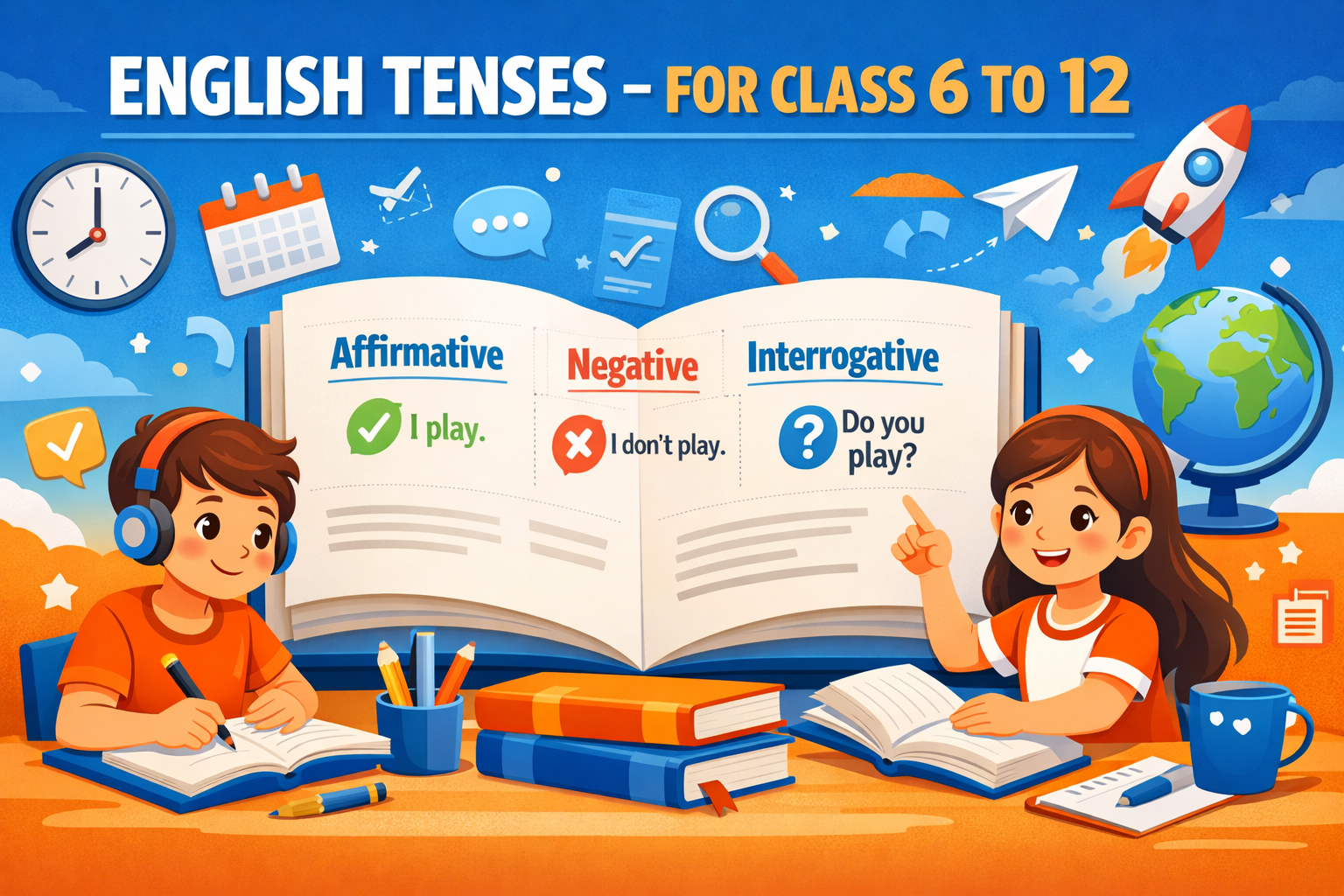
Complete Guide to English Tenses for Class 6 to 12 (Rules, Examples, Affirmative, Negative & Interrogative)
What is a Tense?
A tense shows the time of an action in a sentence.
Simple formula:
Tense = Time of Action
Example:
- I play cricket. (Present)
- I played cricket. (Past)
- I will play cricket. (Future)
English grammar has 3 main types of tenses.
- Present Tense
- Past Tense
- Future Tense
Each tense has 4 forms, so total 12 tenses exist in English grammar.
Complete Tense Chart
| Tense | Structure |
|---|---|
| Present Indefinite | Subject + V1 / V1+s/es |
| Present Continuous | Subject + is/am/are + V1+ing |
| Present Perfect | Subject + has/have + V3 |
| Present Perfect Continuous | Subject + has/have + been + V1+ing |
| Past Indefinite | Subject + V2 |
| Past Continuous | Subject + was/were + V1+ing |
| Past Perfect | Subject + had + V3 |
| Past Perfect Continuous | Subject + had + been + V1+ing |
| Future Indefinite | Subject + will + V1 |
| Future Continuous | Subject + will be + V1+ing |
| Future Perfect | Subject + will have + V3 |
| Future Perfect Continuous | Subject + will have been + V1+ing |
Present Tense
Present tense describes actions happening now or regularly.
1. Present Indefinite Tense
Used for daily routine, habits and universal truths.
Structure:
Subject + V1 / V1+s/es
Examples:
- I play football.
- She reads a book.
- The sun rises in the east.
Use s/es with:
He, She, It, Singular subject
Example:
- He plays
- She writes
- Ram goes
2. Present Continuous Tense
Used for actions happening right now.
Structure:
Subject + is/am/are + V1+ing
Examples:
- I am reading a book.
- She is cooking food.
- They are playing cricket.
3. Present Perfect Tense
Used for actions completed recently.
Structure:
Subject + has/have + V3
Examples:
- I have finished my work.
- She has written a letter.
- They have completed the project.
4. Present Perfect Continuous Tense
Used for actions started in the past and continuing till now.
Structure:
Subject + has/have + been + V1+ing
Examples:
- I have been studying for two hours.
- She has been working since morning.
Use of Since and For
Since → specific time
For → duration of time
Examples:
Since 2020
Since morning
For two hours
For five days
Past Tense
Past tense describes actions that already happened in the past.
5. Past Indefinite Tense
Used for completed actions in the past.
Structure:
Subject + V2
Examples:
- I played cricket yesterday.
- She wrote a letter.
- They visited Delhi.
6. Past Continuous Tense
Used for actions going on in the past.
Structure:
Subject + was/were + V1+ing
Examples:
- I was reading a book.
- They were playing football.
7. Past Perfect Tense
Used for an action completed before another action in the past.
Structure:
Subject + had + V3
Examples:
- I had finished my homework.
- She had left the office.
8. Past Perfect Continuous Tense
Used for actions continuing for some time in the past.
Structure:
Subject + had + been + V1+ing
Examples:
- I had been studying for three hours.
- They had been playing since morning.
Future Tense
Future tense describes actions that will happen in the future.
9. Future Indefinite Tense
Used for simple future actions.
Structure:
Subject + will + V1
Examples:
- I will go to school.
- She will help you.
10. Future Continuous Tense
Used for actions that will be happening in the future.
Structure:
Subject + will be + V1+ing
Examples:
- I will be studying tomorrow.
- They will be travelling next week.
11. Future Perfect Tense
Used for actions that will be completed in the future.
Structure:
Subject + will have + V3
Examples:
- I will have finished my work by evening.
- She will have completed the project.
12. Future Perfect Continuous Tense
Used for actions continuing for a duration in the future.
Structure:
Subject + will have been + V1+ing
Examples:
- I will have been studying for five hours.
- They will have been working for a long time.
Affirmative, Negative and Interrogative Sentences
Every tense sentence can be written in three forms.
- Affirmative
- Negative
- Interrogative
1. Affirmative Sentence
These sentences show that an action is happening.
Rule:
Subject + Helping Verb + Main Verb + Object
Examples:
- She is reading a book.
- They are playing cricket.
- I have finished my homework.
2. Negative Sentence
Negative sentences show that an action is not happening.
Rule:
Subject + Helping Verb + NOT + Main Verb + Object
Examples:
- She is not reading a book.
- They are not playing cricket.
- I have not finished my homework.
Short Forms:
is not → isn’t
are not → aren’t
do not → don’t
does not → doesn’t
will not → won’t
3. Interrogative Sentence
Interrogative sentences ask questions.
Rule:
Helping Verb + Subject + Main Verb + Object ?
Examples:
- Is she reading a book?
- Are they playing cricket?
- Have you finished your homework?
WH Interrogative Sentences
WH words are used to ask specific questions.
WH words include:
What
Why
When
Where
Who
How
Rule:
WH Word + Helping Verb + Subject + Main Verb + Object ?
Examples:
- Why are you laughing?
- Where is she going?
- When will they arrive?
Tips to Learn Tenses Easily
Students can learn tenses easily with these simple tips.
1. Learn Verb Forms
Example:
Go – Went – Gone
Write – Wrote – Written
Eat – Ate – Eaten
2. Practice Daily Sentences
Example:
I am studying.
I studied yesterday.
I will study tomorrow.
3. Remember Helping Verbs
Helping verbs are very important in tense formation.
Examples:
is, am, are
was, were
has, have, had
will, shall
4. Learn the Tense Structure
If students remember the tense structure, grammar becomes much easier.
Importance of Tenses for Students
Tenses are important for students from Class 6 to Class 12 because they help in:
- Writing correct English sentences
- Improving spoken English
- Scoring better in exams
- Understanding grammar easily
Students preparing for school exams and spoken English learning must understand tenses clearly.
Conclusion
Tenses are the backbone of English grammar. Once students understand the 12 types of tenses, they can easily form correct sentences and improve their communication skills.
For students from Class 6 to Class 12, regular practice and understanding of tense rules, helping verbs, and examples will make grammar easy and interesting.
Start practicing daily and you will soon become confident in English grammar.
FAQs
How many tenses are there in English?
There are 12 tenses in English grammar.
What are the main types of tenses?
The three main types are:
Present Tense
Past Tense
Future Tense
Why are tenses important for students?
Tenses help students write correct sentences, improve speaking skills, and perform better in exams.