

If Class 12 Physics had a “foundation chapter,” this would be it.
Electric Charges and Fields is not just Chapter 1 — it’s the base of the entire Electrostatics unit. If you deeply understand this chapter, topics like Electric Potential, Capacitance, and Current Electricity become much easier.
This blog is designed to feel like a premium coaching lecture — concept clarity + derivations + exam strategy + visual imagination.
Let’s begin.
1️⃣ What Is Electrostatics?
Electrostatics is the branch of physics that deals with charges at rest.
Everything in this chapter revolves around one big idea:
Charges create electric fields, and electric fields exert forces.
Before we understand fields, we must understand charge.
2️⃣ Electric Charge — The Starting Point
🔹 What Is Electric Charge?
Electric charge is a fundamental property of matter that causes electrical interaction.
All matter is made up of atoms:
- Protons → Positive charge
- Electrons → Negative charge
- Neutrons → Neutral
SI unit: Coulomb (C)
🔹 Types of Charges
There are only two:
- Positive (+)
- Negative (−)
Like charges repel.
Unlike charges attract.
This naming convention was introduced by Benjamin Franklin.
3️⃣ Basic Properties of Charge (Very Important)
1. Additivity of Charges
Total charge of a system = algebraic sum of individual charges.
If:
- q₁ = +5 C
- q₂ = −2 C
Net charge = +3 C
2. Conservation of Charge
Charge can neither be created nor destroyed.
It can only be transferred.
This principle is valid in all physical processes.
3. Quantization of Charge
Charge exists in discrete packets:

Where:
- n = integer
- e = elementary charge

The experimental verification was done by Robert Millikan using the oil drop experiment.
This means:
You cannot have 0.5e or 2.7e charge.
4️⃣ Coulomb’s Law — The Law of Electric Force
The force between two stationary charges was experimentally studied by Charles-Augustin de Coulomb.
🔹 Statement
The electrostatic force between two point charges is:
- Directly proportional to the product of charges
- Inversely proportional to the square of distance between them
🔹 Mathematical Form
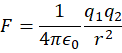
Where:

In vacuum:

🔹 Important Observations
- Force acts along line joining the charges
- It is a vector quantity
- It obeys Newton’s Third Law
🔹 Comparison with Gravitational Force
| Electric Force | Gravitational Force |
| Can repel & attract | Only attracts |
| Very strong | Very weak |
| Depends on medium | Independent of medium |
Electric force is much stronger than gravitational force at atomic scale.
5️⃣ Electric Field — The Real Game Changer
Instead of thinking charges pull each other from a distance, physicists introduced the idea of a field.
The concept of field was developed through ideas of Michael Faraday.
🔹 Definition
Electric field at a point is the force experienced by a unit positive test charge placed at that point.

Unit: N/C
🔹 Electric Field Due to Point Charge
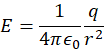
Direction:
- Away from positive charge
- Towards negative charge
6️⃣ Superposition Principle
If multiple charges are present:
Net electric field = vector sum of individual fields.

This principle is extremely important for JEE.
7️⃣ Electric Field Lines — Visualizing the Invisible
Electric field lines help us “see” electric fields.
🔹 Properties
- Start from positive charge
- End at negative charge
- Never intersect
- Closer lines → stronger field
- Tangent gives direction
Special Cases:
- Isolated positive charge → Radially outward lines
- Isolated negative charge → Radially inward lines
- Dipole → Curved lines from + to −
8️⃣ Electric Dipole
Two equal and opposite charges separated by small distance.
🔹 Dipole Moment

Unit: Coulomb-meter
Direction: From negative to positive.
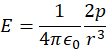
🔹 Electric Field Due to Dipole
On Axial Line:
On Equatorial Line:
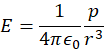
Important:

Notice:
Field decreases as 1/r³ (very important for JEE).
🔹 Torque on Dipole
When placed in uniform electric field:

Stable equilibrium: θ = 0°
Unstable equilibrium: θ = 180°
9️⃣ Electric Flux
Electric flux measures the total electric field passing through a surface.
If surface is perpendicular:

If at angle:

Unit: N·m²/C
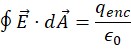
🔟 Gauss’s Law — The Most Powerful Tool
Given by Carl Friedrich Gauss.
🔹 Statement
Total electric flux through a closed surface is:

🔹 Mathematical Form
Important:
- Only enclosed charge matters
- Outside charge contributes zero net flux
Applications of Gauss’s Law
Works only when symmetry exists.
1️⃣ Infinite Line Charge

2️⃣ Infinite Plane Sheet

Field is constant (independent of distance).
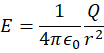
3️⃣ Spherical Shell
Outside:
Inside:

This is a favorite board question.
Most Important Exam Areas
For Boards:
- Derivations of Coulomb’s law
- Field due to dipole
- Gauss law proof
- Field inside spherical shell
For JEE:
- Multi-charge superposition
- Dipole field problems
- Graph questions (E vs r)
- Symmetry-based Gauss problems
Graph Concepts You Must Know
- E vs r for point charge → decreases as 1/r²
- E vs r for dipole → decreases as 1/r³
- E vs r for spherical shell → zero inside
Common Mistakes Students Make
- Ignoring vector nature
- Forgetting sign conventions
- Using Gauss law without symmetry
- Mixing axial & equatorial dipole formula
Final Strategy to Master This Chapter
Step 1: Understand concepts deeply
Step 2: Memorize key formulas
Step 3: Practice numericals daily
Step 4: Revise derivations weekly
If this chapter becomes strong, the next chapters become easier automatically.
✨ Final Words
Electric Charges and Fields is not just Chapter 1.
It is the language of electrostatics.
Master it once — and you unlock half of Class 12 Physics.